Rudraksha Testing
& X-Ray Certification
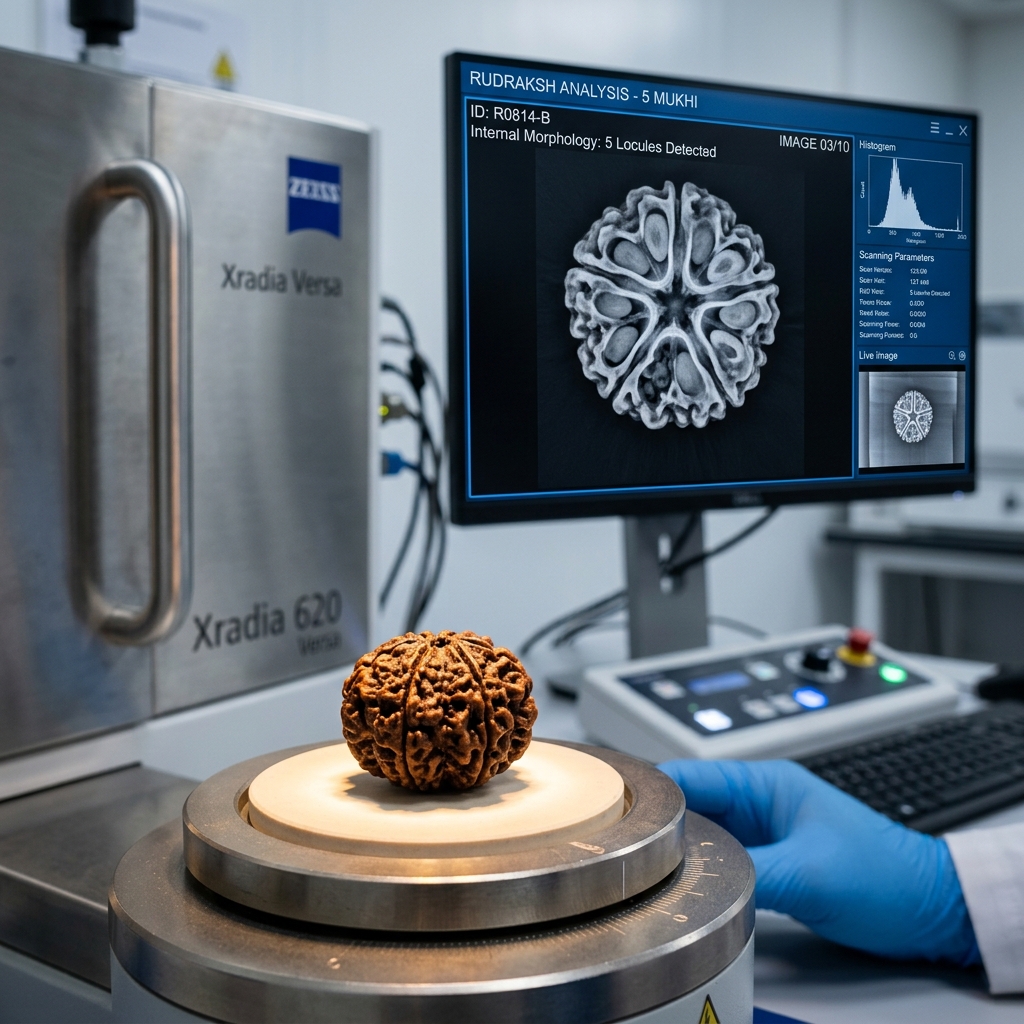
Using state-of-the-art digital radiography, specific gravity density calculations, and microscopic botanical profiling, we reveal the internal truth of sacred seeds. As the premier Rudraksha testing laboratory in Delhi, we protect collectors against artificial lines, glued compartments, and composite fakes.
Advanced Verification Protocols
Our gemstone and Rudraksha certification Rohini center isolates genuine Elaeocarpus ganitrus seeds from elaborate human manipulation.
Digital Radiography
The ultimate verification test. A genuine bead has internal seed cavities (chambers) matching its external facets (Mukhis) exactly. X-Ray immediately exposes carved lines or composite beads with no internal seeds.
Density Profiling
Using hydrostatic balance to determine density. Synthetic resins, wood-paste additions, and lead weights used to fake rare, heavy beads are easily detected by deviation from organic density thresholds.
Botanical Profiling
Inspecting structural furrows, natural fibers, and cell walls under digital magnification. This excludes plastic casting, wood carving, or seeds of other botanical species.
Vedic Rudraksha Classifications
| Mukhi (Faces) | Planetary Ruler | Internal Chambers Required | Common Counterfeits |
|---|---|---|---|
| 1 Mukhi (Round) | Sun (Surya) | 1 Chamber (Exceedingly Rare) | Carved 5-Mukhi beads, or half-moon cashew seeds |
| 7 Mukhi | Venus (Shukra) | 7 Symmetric Chambers | Artificial line carvings on standard beads |
| 12 Mukhi | Sun (Surya) | 12 Chambers | Segments glued together using adhesive resins |
| 14 Mukhi (Dev Mani) | Saturn (Shani) | 14 Chambers | Extremely high-value counterfeits made from wood dust |
Frequently Asked Questions
Find answers to the most common queries regarding digital X-Ray radiography, specific gravity tests, and botanical identification of Rudraksha seeds.
Why is digital X-Ray imaging used to verify Rudraksha beads?
keyboard_arrow_down
What are the common ways counterfeit Rudraksha beads are made?
keyboard_arrow_down
How does Delhi Gold Testing verify a 1 Mukhi (one-faced) round Rudraksha bead?
keyboard_arrow_down
What botanical checks are performed to verify genuine Elaeocarpus ganitrus seeds?
keyboard_arrow_down
Certify Your Sacred Beads
Protect your spiritual practices. Every verified seed receives an official certificate with X-Ray photograph attachments from our Rohini laboratory.
Book X-Ray Scan